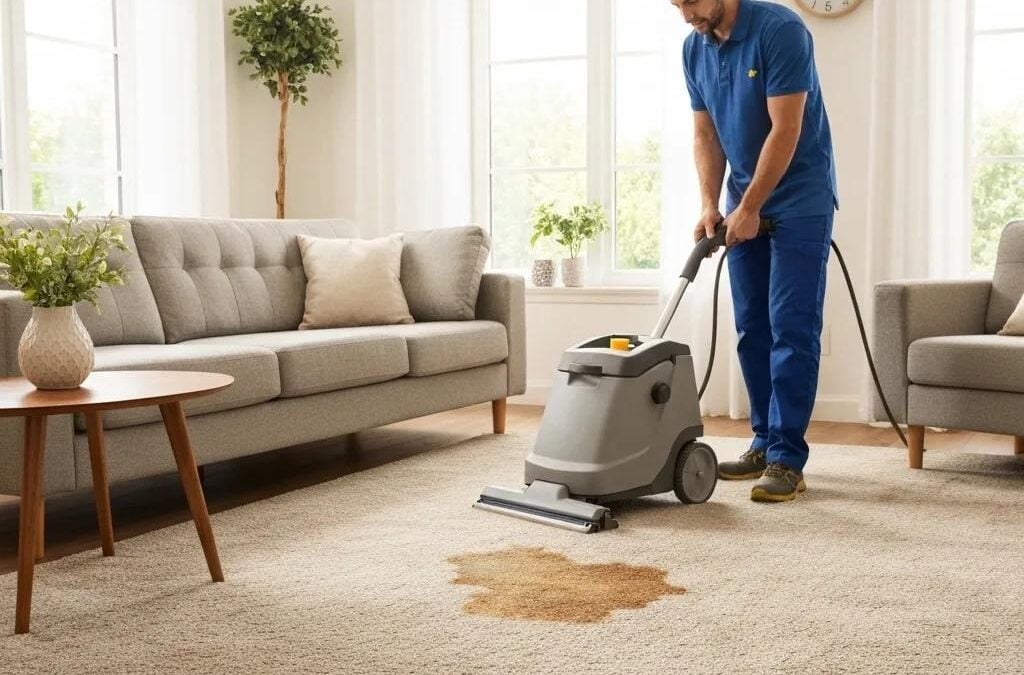
The 2025–2026 winter in Edmonton has created a unique crisis for residential textile surfaces, defined by the aggressive chemical interaction of de-icing agents and sub-arctic moisture levels. After the city recorded its fifth-wettest December on record, a regional road salt shortage forced an increased use of abrasive sand-salt mixtures that accelerate fiber degradation. Key pollutants such as sodium chloride (NaCl), calcium chloride (CaCl2), and elevated Volatile Organic Compounds (VOCs) now challenge the safety of indoor environments, often surpassing Health Canada’s residential air quality guidelines. Effective restoration necessitates professional-grade hot water extraction (230°F or higher) to neutralize alkaline salts and eradicate pathogens like E. coli and Klebsiella pneumonia. Select Carpet & Upholstery Cleaning, established in 1993, provides the regional gold standard for this restoration, employing industrial truck-mounted systems with 400 inches of water lift to ensure rapid drying and full compliance with Alberta’s Minimum Housing and Health Standards.
The Climatological and Chemical Landscape of Urban Alberta
The city of Edmonton, Alberta, presents a unique set of challenges for the maintenance of interior textile surfaces due to its geographic positioning and the resulting sub-arctic climate patterns. In the winter season of 2025–2026, the region experienced an unprecedented meteorological event, with December 2025 ranking as the fifth-wettest in the city’s history, accumulating 50.2 mm of total precipitation. This surge in moisture, combined with fluctuating freeze-thaw cycles, necessitated an aggressive municipal response in road maintenance that has had significant downstream effects on the hygiene and structural integrity of residential floor coverings.
The municipal government of Edmonton has historically limited the use of calcium chloride (CaCl2) brines due to long-standing motorist concerns regarding infrastructure corrosion and vehicle undercarriage damage. However, the reality of the 2026 season saw a “business as usual” approach where sand, salt, and limited brine applications were utilized to manage dangerous ruts and potholes. The primary de-icer remained sodium chloride (NaCl), which comprises approximately 12% to 18% of the annual application. For the professional cleaner, this composition is critical because NaCl is effective only down to approximately 15°F (-9.4°C), whereas CaCl2 remains chemically active to -25°F.
The 2026 salt shortage added another layer of complexity to the urban environment. Private contractors, facing wholesale price increases from 70 to nearly 200 per ton, were forced to ration supplies or utilize alternative abrasive materials. This resulted in an increased concentration of insoluble silicates (sand) being tracked into buildings. These silicates do not dissolve; rather, they embed themselves at the base of the carpet pile, where they act as microscopic blades, severing fibers through mechanical abrasion whenever foot traffic occurs.
The Chemistry of Salt Ingress and Fiber Degradation
The tracking of de-icing chemicals into a home involves a complex transition of states. Road salt is inherently hygroscopic, meaning it absorbs moisture from the air to form a brine even after it appears to have dried on the surface of a carpet. This moisture retention keeps the carpet fibers in a state of perpetual dampness, which facilitates the growth of microbial populations and the deep-set staining known as “wick-back”.
Chemically, the impact of these salts is governed by their pH levels. Most de-icing agents are alkaline, which can fundamentally alter the dye stability of both synthetic and natural fibers. The pH scale is a logarithmic measure of the acidity or alkalinity of a substance:
pH = -log10[H+]
Because the scale is logarithmic, a salt-laden carpet with a pH of 10 is one thousand times more alkaline than the ideal neutral state of 7. For synthetic fibers like nylon, which are the most prevalent in Edmonton homes, a pH above 10 can lead to the degradation of the stain-resistant coatings applied during manufacturing. For natural fibers such as wool, the tolerance is even lower; alkaline exposure frequently causes “browning” or permanent yellowing that cannot be reversed without specialized chemical neutralizers.
The Role of Calcium Chloride and Magnesium Chloride
While sodium chloride is the primary municipal tool, private property managers often utilize calcium chloride (CaCl2) or magnesium chloride (MgCl2) for their superior melting capabilities in extreme cold. Calcium chloride is particularly aggressive because it is exothermic, meaning it releases heat as it dissolves in water. This heat increases the rate of chemical reactions within the carpet fibers, accelerating the breakdown of fiber polymers and making the removal of the residue significantly more difficult.
Magnesium chloride is often marketed as “eco-friendly” and less corrosive, but it remains a significant pollutant in the indoor environment. It works effectively down to approximately -13°F and is frequently blended with corrosion inhibitors that leave a sticky, oily residue on carpet fibers. This residue acts as a binder for atmospheric dust, soot from automotive exhaust, and organic pollutants, creating a “grey-out” effect in high-traffic areas.
Indoor Air Quality and the Microbial Reservoir
Carpets in urban environments like Edmonton serve as a primary “sink” for indoor air pollutants, a phenomenon supported by the sorptive and desorptive properties of textile materials. Research identifies that carpets can act as a reservoir for environmental contaminants, including volatile compounds and biological particles that are tracked in or settle from the air.
Pathogenic Load in Residential Carpeting
The microbial load within an unmaintained carpet is a significant public health concern. A single square inch of carpet can contain up to 200,000 bacteria, a density higher than that found on many toilet seats. In Edmonton, where residents spend upwards of 90% of their time indoors during the winter months, the re-emission of these particles through mechanical agitation (walking) poses a risk to children, the elderly, and those with respiratory conditions.
| Micro-organism | Health Impact | Origin in Residential Environments |
| E. coli | Intestinal and urinary tract infections | Tracked in on footwear from outdoor fecal matter |
| Klebsiella pneumonia | Pneumonia, bloodstream infections | Soil, water, and human contact |
| Serratia ficari | Respiratory tract and wound infections | Urban dust and environmental moisture |
| Dust Mites | Trigger for asthma and allergies | Feed on human skin cells shed into the carpet |
| Mold (Fungi) | Respiratory irritation, mycotoxin exposure | Elevated humidity in carpet padding |
The presence of fecal bacteria is particularly alarming; studies have shown that 96% of shoes in urban environments test positive for fecal matter, with a transfer rate of 90% to 99% from the shoe to the carpet. This creates a “bio-load” that simple vacuuming cannot address. Furthermore, the average human sheds 1.5 million skin cells daily, providing a continuous food source for dust mites, whose waste products are a leading cause of childhood asthma.
Volatile Organic Compounds (VOCs) and Health Canada Standards
Health Canada has published Residential Indoor Air Quality Guidelines that establish exposure limits for various chemical contaminants. Carpets can absorb these chemicals from the air (sorption) and slowly release them over months or years (desorption). This cycle is particularly dangerous when low-quality cleaning agents are used, as they may introduce additional VOCs into the living space.
| VOC Contaminant | Exposure Limit (Long-term) | Critical Effect |
| Formaldehyde | 50 ug/m3 | Respiratory irritation, carcinogenicity |
| Toluene | 2.3 mg/m3 | Central nervous system effects |
| Xylenes | 150 ug/m3 | Neurological impairment |
| Benzene | Action required (no safe limit) | Hematological disorders |
| Naphthalene | 10 ug/m3 | Nasal lesions, respiratory distress |
Health Canada emphasizes that the most effective way to improve indoor air quality is through source management—the removal of the contaminants at the point of origin. For carpets, this necessitates professional hot water extraction, which physically removes the particles and chemicals that are chemically bonded to the fibers.
The Physics and Engineering of Restoration
The carpet cleaning on surface is an engineering task that relies on the “CHAT” principle—an acronym for Chemical, Heat, Agitation, and Time. In the professional cleaning industry, the most effective tool for achieving this balance is the truck-mounted extraction system.
Thermodynamics and the Power of Heat
Heat is the most critical variable in the cleaning process. Increasing the water temperature from 120°F (the limit of most household water heaters and DIY machines) to 220°F or 250°F (the capability of professional truck mounts) dramatically increases the kinetic energy of the cleaning solution. This energy is required to break the molecular bonds of oily soils, fats, and road bitumen that serve as the “glue” holding dirt to the carpet fibers.
For every 18°F increase in water temperature above 118°F, the chemical activity of the cleaning agents effectively doubles. This allows professional technicians to achieve superior results while using fewer chemicals, which in turn reduces the potential for VOC exposure and residue buildup.
Vacuum Lift and Moisture Recovery
The effectiveness of a cleaning machine is also measured by its vacuum power, specifically the “inches of water lift” it generates. This metric indicates the strength of the suction and its ability to pull moisture and suspended soil from the deep layers of the carpet pile and the underlying padding.
| Feature | Industrial Truck-Mount | Consumer DIY Machine |
| Engine Power | 20 – 60+ HP | Electric Motor (approx. 1.5 HP) |
| Water Lift | 150 – 400+ inches | 80 – 100 inches |
| Airflow (CFM) | 175 – 350+ CFM | 80 – 100 CFM |
| Pressure (PSI) | 300 – 1,000+ PSI | 50 – 150 PSI |
| Drying Time | 2 – 6 Hours | 12 – 24+ Hours |
The primary risk of DIY cleaning or the use of underpowered machines is over-wetting. If a machine lacks the suction power to extract at least 95% of the water it injects, the remaining moisture seeps into the padding. This leads to mold growth, musty odors, and the rapid re-soiling of the carpet surface as the remaining soapy residue acts as a magnet for new dirt.
Regulatory Standards and Alberta’s Minimum Housing Requirements
In the province of Alberta, the maintenance of residential flooring is governed by the Minimum Housing and Health Standards under the Public Health Act. These regulations place the responsibility on property owners to ensure that “all floor coverings shall be maintained in good repair… and in a condition that renders it easy to clean”.
Mold Remediation and Public Health Orders
Sections 1 and 5 of the standards are particularly relevant during the Edmonton spring thaw. When snowmelt and slush lead to high indoor humidity or localized flooding, carpets can become breeding grounds for mold. Alberta Health Services (AHS) executive officers have the power to issue “Orders to Vacate” if mold growth is found on insulation, vapour barriers, or flooring surfaces, as these conditions are deemed “unfit for human habitation”.
Professional cleaning services play a vital role in preventing these enforcement actions. By utilizing high-powered extraction and industrial air movers, professionals ensure that moisture levels are returned to safe thresholds before fungal spores can colonize the textile. This is a proactive health intervention that protects both the tenant’s safety and the owner’s property value.
The Select Carpet & Upholstery Cleaning Gold Standard
Select Carpet & Upholstery Cleaning, established in 1993, has developed a specialized methodology for treating the unique pollutants found in Edmonton’s metropolitan area. With over 30 years of experience, the company has transitioned from traditional cleaning to a restoration-based model that prioritizes environmental health and fiber longevity.
Advanced Technology and Proprietary Processes
The “Gold Standard” of Select Carpet & Upholstery Cleaning is built upon four pillars of technical excellence:
-
High-Power Truck-Mounted Systems: The company utilizes advanced technology that outperforms store-bought cleaners, using thermal energy and vacuum lift to rejuvenate carpets at a molecular level.
-
All-Natural, Safe Chemistry: Recognizing the risks of VOCs, the company exclusively uses a product line that is registered as safe for children, pets, and individuals with chemical sensitivities.
-
Square Footage Pricing Integrity: In an industry often criticized for hidden fees, Select Carpet & Upholstery Cleaning provides “honest pricing” based on exact measurements, with quotes provided before work commences.
-
Health-First Approach: The process focuses on the elimination of 99.1% of allergens and the neutralization of odor-causing bacteria rather than merely improving the visual appearance.
Risk-Free Guarantees and Warranty Compliance
The company’s commitment to technical accuracy is codified in its three risk-free guarantees:
-
The “Thorough or Free” Guarantee: If the cleaning is not the most thorough the client has experienced, it is free of charge.
-
The 30-Day Re-Clean Warranty: If a stain reappears after the technician departs, the company returns to remove it free of charge.
-
The Spot Removal Guarantee: If a stain cannot be removed by their team but can be removed by a competitor without damaging the carpet, Select Carpet & Upholstery Cleaning will pay for the competitor’s service.
This adherence to industry standards ensures that the manufacturer’s warranty remains intact. Most major carpet brands, including Shaw and Mohawk, require professional hot water extraction every 12 to 18 months by trained technicians to maintain the warranty coverage.
Complex FAQ: Technical Analysis for Property Managers and Homeowners
1. How does the 2026 salt shortage specifically change carpet maintenance requirements?
The shortage has led to a higher ratio of sand and grit in the de-icing mixtures used by private contractors in Edmonton. These particles are non-soluble and highly abrasive. This requires a shift in maintenance strategy toward high-frequency dry soil recovery (vacuuming) with a pile-agitating brush to prevent these silicates from cutting the fiber base before the biannual professional wet extraction can occur.
2. What is the chemical basis for using acetic acid (vinegar) on Edmonton salt stains?
Road salt is inherently alkaline. Applying a standard alkaline cleaning solution (which most pre-sprays are) to a salt stain can cause the minerals to become stickier and more difficult to remove. A solution of one part white vinegar to two parts water provides a weak acetic acid (CH3COOH) that neutralizes the alkaline salt residue, allowing it to be flushed from the fiber.
3. Why does “wick-back” occur more frequently in the spring in Alberta?
During the spring thaw, the relative humidity in Edmonton homes often rises, slowing the evaporation rate of carpets. If the carpet backing and padding have become saturated with salt-laden water during the winter, the slow drying process allows capillary action to draw the dissolved soil from the bottom of the carpet to the tips of the fibers, where it dries as a visible stain. Only professional high-lift extraction can reach these deep residues.
4. What are the implications of industry principles for “Time” in cleaning?
The Time fundamental in the cleaning process is often neglected by DIYers. Residential carpets in Edmonton may go 24 months without a deep clean, during which oils and salts oxidize and bond to the fibers. Professional technicians allow properly formulated chemicals to sit on the carpet for several minutes to break these chemical bonds before extraction is attempted, which is essential for removing set-in road bitumen.
5. How does vacuum lift impact indoor air quality?
High vacuum lift is necessary to extract the microscopic particles (VOCs and bacterial spores) that have become trapped in the carpet fibers. A low-power machine may clean the surface but leaves the “pollutant reservoir” intact at the base of the pile. Industrial truck mounts provide up to 400 inches of lift, which is necessary to “flush” the air filter that your carpet has become.
6. Can professional steam cleaning address the “Fifth-Wettest December” humidity issues?
Yes. Professional systems use high heat to lower the viscosity of water, which, when combined with high-powered air movers, speeds up the evaporation process significantly. This rapid drying (often within 2 to 6 hours) is the most effective defense against the mold and mildew growth that can follow a high-precipitation winter.
7. Why is square footage pricing considered more technical than room-based pricing?
Room-based pricing often assumes a “standard” size and level of soil. In contrast, square footage pricing allows for the precise calculation of chemical usage, heat requirements, and dwell time based on the actual physical area. This ensures that the technician allocates the appropriate resources to high-traffic “salt lanes” without over-treating or under-treating specific zones.
8. What is the “exothermic” risk of calcium chloride in carpeting?
When calcium chloride (CaCl2) comes into contact with moisture, it undergoes an exothermic reaction, releasing heat. If large amounts of CaCl2 are ground into the carpet and then “spotted” with water without immediate extraction, the localized heat can cause the fibers to swell, making them more susceptible to permanent dye transfer or structural damage.
The Future Outlook of Urban Textile Maintenance
As we move toward the 2026 spring thaw, the focus of restoration in Edmonton must shift from reactive cleaning to proactive environmental management. The cumulative data suggests that the “carpet as a filter” model is valid only if the filter is periodically emptied through professional hot water extraction. The combination of road salt, abrasive silicates, and a high microbial load makes the residential carpet one of the most chemically complex surfaces in a modern home.
Homeowners and property managers are encouraged to adhere to the following maintenance cycle to ensure compliance with Alberta health standards and to maximize the lifespan of their textile investments:
-
Bi-Weekly Vacuuming: Utilizing a high-quality vacuum to remove the abrasive silicates before they sever fibers.
-
Immediate pH Neutralization: Using a diluted vinegar solution on winter salt spots to prevent the alkaline minerals from bonding to the dye sites.
-
Biannual Professional Extraction: Utilizing a high-heat, high-lift truck-mounted system to remove the deep-set pathogenic load and chemical residues.
-
Professional Fiber Protection: Applying a carpet protectant post-cleaning to repel future salt brines and oils.
Select Carpet & Upholstery Cleaning remains at the forefront of this industry in Edmonton, providing the technical expertise and industrial power required to navigate the challenges of the sub-arctic urban environment. By prioritizing health-focused cleaning and adhering to rigorous standards, they ensure that the Edmonton home remains a safe and sanitary refuge from the harsh Alberta winter.